






Enterprise Search and Knowledge Assistance
Help authorized users find answers across policies, product information, research, technical documentation and institutional knowledge, with sources shown where appropriate.


Trusted by Leading Enterprises
Generative AI development helps businesses build software that creates or transforms content using foundation models. It covers use-case design, data and retrieval architecture, engineering, integrations, security, deployment, evaluation and continuous improvement.

We believe a structured approach leads to better outcomes
Generation or transformation tasks with clear instructions and structured inputs.
Best suited to
Generation or transformation tasks with clear instructions and structured inputs.
Key proof required
Repeatable output quality on representative cases.
Important limitation
Behavior may vary as inputs and models change.
Patterns
Generation or transformation tasks with clear instructions and structured inputs.
Best suited to
Generation or transformation tasks with clear instructions and structured inputs.
Key proof required
Repeatable output quality on representative cases.
Important limitation
Behavior may vary as inputs and models change.
Help authorized users find answers across policies, product information, research, technical documentation and institutional knowledge, with sources shown where appropriate.
Provide self-service answers, agent assistance, conversation summaries, response drafting, routing and escalation within existing service operations.

Extract fields, compare clauses, summarize cases, draft reports and route exceptions for human review.
Generate and adapt product copy, learning materials, campaigns, proposals or internal communications through controlled templates and approval workflows.
Prepare research, meeting briefs, personalized drafts, opportunity summaries and recommended next actions using governed business data.
Support code explanation, test generation, documentation, migration analysis and developer workflows with repository and permission controls.
Transform questions into governed analysis and summaries with traceable data.
Add generation, conversational interfaces, intelligent search, personalization or multimodal capabilities to a new or existing software product.
Help authorized users find answers across policies, product information, research, technical documentation and institutional knowledge, with sources shown where appropriate.
Provide self-service answers, agent assistance, conversation summaries, response drafting, routing and escalation within existing service operations.
Extract fields, compare clauses, summarize cases, draft reports and route exceptions for human review.
Generate and adapt product copy, learning materials, campaigns, proposals or internal communications through controlled templates and approval workflows.
Prepare research, meeting briefs, personalized drafts, opportunity summaries and recommended next actions using governed business data.
Support code explanation, test generation, documentation, migration analysis and developer workflows with repository and permission controls.
Transform questions into governed analysis and summaries with traceable data.
Add generation, conversational interfaces, intelligent search, personalization or multimodal capabilities to a new or existing software product.
When the opportunity is broader or the data environment is uncertain, AB Ark begins by defining the workflow, users, evidence and controls needed for a responsible build.

Document the current tasks, decisions, handoffs, exceptions, volumes and baseline performance.
Compare expected value, feasibility, risk, adoption effort and data readiness across candidate opportunities.
Review source quality, ownership, access, freshness, permissions and gaps.

Compare providers, model classes, retrieval patterns, hosting approaches, integrations and build-versus-buy choices.
Define representative test cases, baselines, quality thresholds, risk tests and business success measures.

Recommend the first experiment, scope boundaries, dependencies, team, estimated stages and next decision.
Define which information the system may access, store, transform or send to a model provider.

Apply user, role and document-level access so retrieval and actions respect existing authorization.

Capture model, prompt, source, tool, output, user action and decision context at a level appropriate to the system and privacy requirements.

Use approvals, escalation and override paths when errors could create material customer, financial, legal, safety or operational harm.

Design for prompt injection, malicious documents, unsafe links and attempts to override instructions.

Use staged release, adversarial testing, user acceptance and rollback plans before increasing autonomy or audience.

Name who reviews incidents, model changes, content freshness, vendor updates, access and evaluation results.
Users, workflow, scope, baseline, success measures, constraints, risks and acceptance criteria.
The agreed product, POC or feature with application logic, experience, model integration and required workflows.
Approved sources, ingestion, chunking/indexing approach, permissions, freshness and retrieval design where applicable.
Representative test cases, rubrics, graders, baselines, results, failure analysis and release thresholds.
APIs, connectors, configuration, environments, infrastructure guidance and release documentation.
Data boundaries, access, guardrails, human review, logging, incident and change-management requirements.
Agreed code, setup instructions, architecture notes, runbooks and handover materials, with ownership defined in the engagement terms.
Prioritized improvements for quality, cost, latency, retrieval, adoption, governance and future capabilities.

We connect model capabilities to the workflow, user, decision and measurable outcome the organization needs.

We compare suitable commercial and open-weight options against quality, privacy, latency, cost, deployment and maintenance requirements.

Our work covers the application, experience, data, integrations, infrastructure and operational controls around the AI capability.

We define how quality will be measured and test representative cases before recommending broader deployment.

Permissions, data boundaries, guardrails, logging, human review and incident ownership are designed with the workflow.

We can begin with discovery or a POC, then support productionization, integration, managed optimization or added engineering capacity.


Explore our case studies and client success stories where AB Ark AI engineers helped build
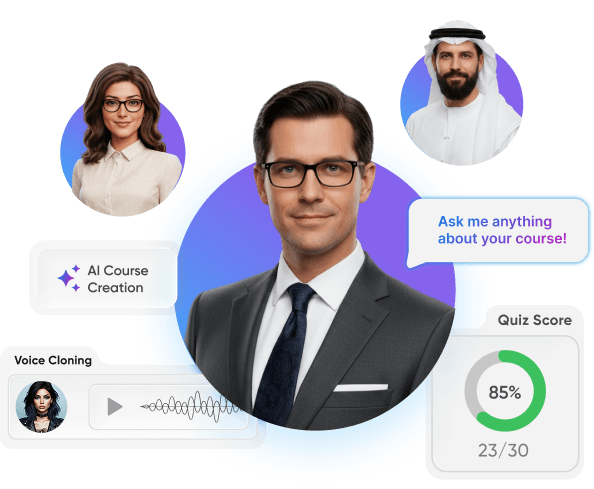
Vocaliv helps training institutes scale course delivery, reduce trainer workload, and launch new programs faster through AI-powered lesson planning, voice-based content creation, automated quizzes, and 24/7 student support.

Modern businesses lose countless opportunities simply because they cannot answer every incoming call. The AI Receptionist Platform solves this problem by providing businesses with a 24/7 intelligent voice assistant that answers calls instantly, manages bookings, and supports customers with natural conversations.

AI4Real automates real estate marketing with intelligent video creation. It combines AI, property data analysis, and templates for agencies to create professional videos instantly.

AB Ark transformed Eventas AI into a self-operating ecosystem, replacing manual chaos with a high-precision AI Command Center.

Modern businesses often rely on multiple disconnected systems to manage tasks, communication, data, and workflows. The All-in-One Business Platform consolidates these essential tools into a single, centralized ecosystem that simplifies operations and enhances productivity across teams.

QS Learning and Ab Ark built a Smart Online Academy, turning a traditional tutoring center into a seamless digital platform. With automated scheduling, an integrated classroom, and an SEO-optimized website, parents and students can easily find, book, and attend classes anytime.

CL Manager at Ebana

CEO at VYB Digital

CEO at Brightway

Director at SA Property Investors Network
CL Manager at Ebana
CEO at VYB Digital
CEO at Brightway
Director at SA Property Investors Network
Have questions? We've answered the most common queries to help you get started.

JOB SUCCESS

WORKING HOURS

HAPPY CLIENTS

PROFESSIONAL TEAM